
Who’s on Your Board?
Some people hold your heart. Others hold your strategy. You need both.

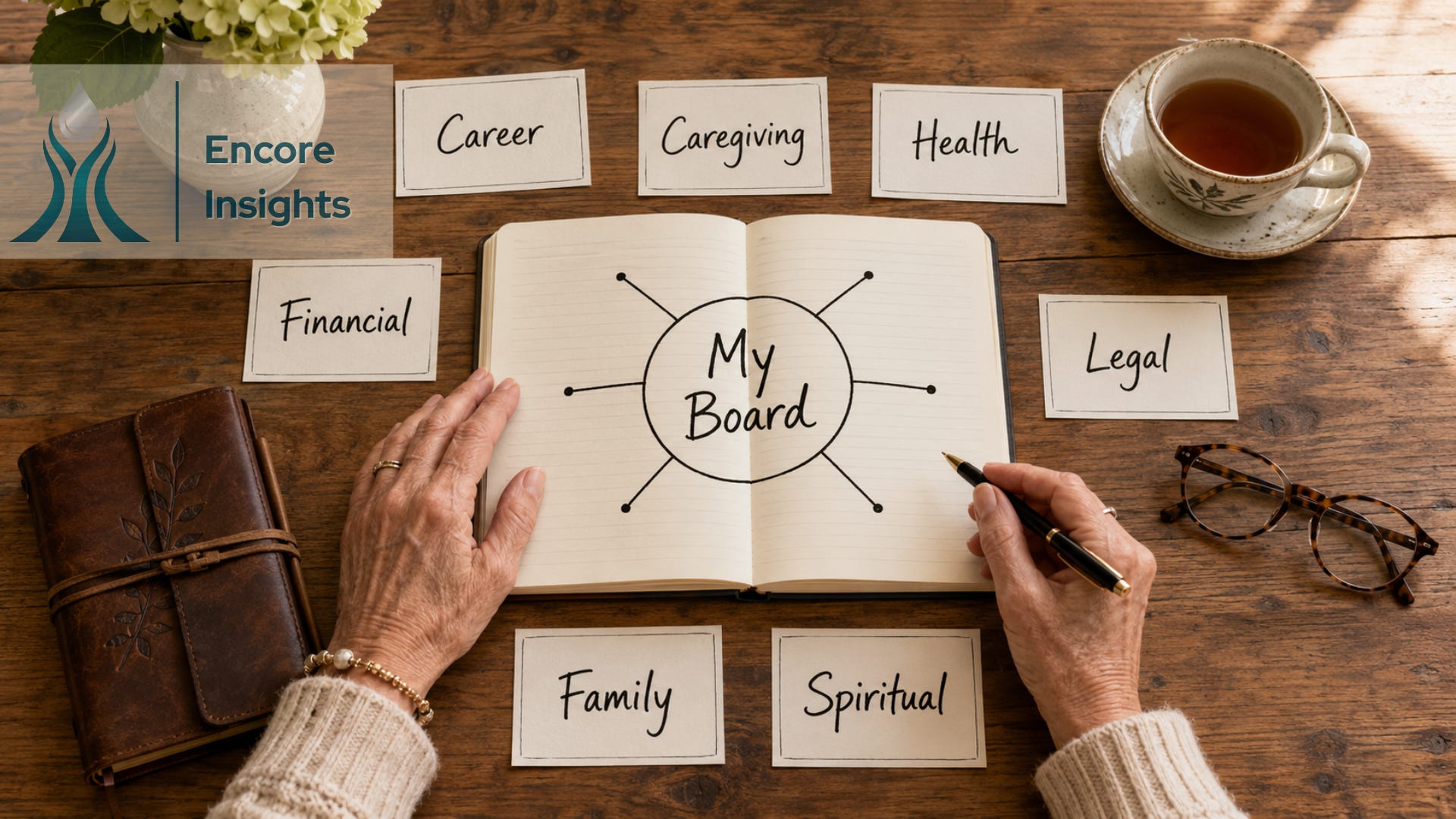
There’s a question I’ve been sitting with lately. It came up after a season of carrying more than I let on to most people. The question isn’t dramatic, but honest.
Who do I actually turn to — and for what?
It sounds simple until you try to answer it. Because when life gets complicated, as it tends to after 50, the needs don’t arrive neatly. They show up layered and sometimes shapeless. They’re part professional, part personal, part grief, and part uncertainty about what comes next.
And if we haven’t thought carefully about who’s in our corner, we tend to do what feels natural: we turn to whoever is closest and most trusted and ask them to hold all of it.
Which is a lot to ask of one person.
I remember a workshop moment that has stayed with me. We were exploring the idea of building what I call a Personal Board of Directors. It’s that group of people we learn to gather around us, each one helping us carry a different part of life.
I asked the women in the room to help me list the areas where they sometimes need guidance or support. They brought up things like career decisions, financial questions, family complexity, grief, health changes, and professional reinvention. Then I asked them to name who they currently turn to for each.
One woman went quiet for a moment, then looked up with a small, knowing smile. She’d written the same name for nearly everything on her list. It was her best friend for twenty years.
Before she said a word, heads were nodding around the room. She wasn’t the only one.
What followed was one of those conversations that takes on a life of its own.
For many of them, it was the first time they’d thought to question the arrangement at all — and questioning it felt less like criticism of their friendships than like an opening.
The friend who holds your history, who knows the whole story, and who will sit with you in the hard stuff without trying to fix it, is irreplaceable. She may not, however, be the right person to help you think through a career pivot, navigate a legal question about an aging parent’s estate, or find your footing after a professional loss. Those conversations call for a different kind of knowing.
That distinction matters more than we usually admit.
Some People Hold Your Heart
There are people in our lives whose primary gift is presence. They know us before the titles, before the accomplishments, and before the transitions we’ve navigated. They’re the ones we call when something happens, and we don’t yet have words for it. They hold our history, our humor, our most private fears, and they love us without requiring us to be okay.
These are the people who hold your heart. And in the seasons when the ground has shifted — a diagnosis, a loss, a change that arrived without warning — they are exactly who you need.
A woman I know lost her husband two years ago. The grief didn’t follow any predictable schedule. It would arrive in the middle of an ordinary Tuesday, or ambush her in the produce aisle when she reached for something he used to like. Her closest friends showed up beautifully in the early months, offering meals, their presence, and many long phone calls. But as time went on and the grief stayed, she began to sense that the people who loved her most were also wishing her to be better. They weren’t being unkind, just human. And she started editing herself around them, protecting them from the weight of a grief that hadn’t yet finished its work.
She didn’t need different friends. She needed to expand her Board. It was time to find someone, like a counselor, a grief group, or a coach who had walked that territory, and whose specific gift was holding grief without rushing it. These are the specialists who could meet her exactly where she was without needing her to move along.
That’s not a criticism of her friends. It’s just an honest description of what different people are equipped to handle.
Others Hold Your Strategy
There’s a different kind of support that has nothing to do with emotional presence and everything to do with perspective, expertise, and honest counsel.
You might have a mentor who has navigated the professional terrain you’re entering, or a financial advisor who helps you ask the questions you didn’t know to ask. A coach who can hold both your uncertainty and your potential without collapsing the distance between them. Or a trusted colleague who will tell you the truth about how something is landing from the outside.
These are the people who hold your strategy. And they matter just as much.
A client came to me some years ago in the middle of a career transition she hadn’t chosen. Her company had restructured, her role had disappeared, and she was in that disorienting space between what was and what might be next. She had wonderful friends who loved her and told her she’d be fine, and a sister who listened patiently to every version of her worry.
But what she didn’t have was anyone who could help her think clearly about what she actually wanted, the value she brought with her, what her experience was worth in the current market, or how to talk about her transition in a way that opened doors rather than raising questions.
Her heart was well held, but her strategy was unguided.
Once she began building that side of her Board, with a career coach, a mentor in the field she was moving toward, and a peer group of women navigating similar reinventions, the fog began to lift because she was no longer thinking alone.
The Gap Nobody Talks About
Here’s what also came up in that workshop, once the conversation opened. Some women realized they didn’t just have the wrong person in a role, but they had a gap. They had a need with no one to fill it yet.
One woman was dealing with the early stages of her mother’s cognitive decline. She had family around her, friends who cared, and a job she was trying to hold together while managing the new weight of it all. But she had no one on her Board who knew anything about navigating the medical system, understanding care options, or simply sitting with the particular grief of watching a parent disappear incrementally. She hadn’t failed to build her Board; she just never needed that before.
The room got quiet in a way that felt like recognition.
What do you do when you have a gap? You start by naming it, which is harder than it sounds because we often don’t notice a gap until we’re standing in it.
Then you ask the people you already trust: “Do you know someone?” Getting a trusted friend’s referral to a financial planner, an estate attorney, a therapist who specializes in grief or transition is how many of us find the people who end up mattering most. We don’t have to do a search; we just need to have a conversation with someone who already knows us.
BoldTimers exists, in part, for exactly this. A community of experienced professionals who have navigated enough to know things, and who are generous with what they know.
Your Board Is Not Fixed
This is perhaps the most important thing I’ve learned, both from my own experience and from watching clients move through significant transitions.
The Board you needed five years ago is probably not the Board you need now.
The mentor who guided your climb may not be the right voice for your reinvention. The friends who supported you through a divorce may not know how to support you through a career pivot. The coach who helped you build something may be different from the coach who helps you step back from it with grace. Life keeps changing, and the people best equipped to walk alongside us keep changing too.
You’re not being disloyal. You’re being honest about what you need, and who is genuinely equipped to give it in this season. Revisiting your Board isn’t a sign that something has gone wrong. It’s a sign that you’re paying attention.
Call yours whatever feels like a good fit — your Personal Board of Directors, your Inner Circle, your Front Row, your Band of Angels. The name matters less than the intention. What matters is that you’ve thought about it. That you know who holds your heart when the weight gets heavy, and who holds your strategy when the path gets unclear. That you’ve noticed any gaps, and started asking the right people how to close them.
The other thing that matters is that you’re not trying to do all of this on the strength of one good friend alone — however wonderful she is.
Who’s on your Board right now? Does it reflect what you actually need in this season?
If something feels thin or missing, that’s not a problem to solve today, but it’s worth noting. And it’s worth one honest conversation with someone you already trust.
María Tomás-Keegan is Co-Founder & Chief Coaching Officer of BoldTimers, a movement helping experienced professionals navigate what’s next with clarity, courage, and community. She’s also a career and leadership coach, award-winning author, and creator of the Ripple Journey transition framework for life and work. She writes about the people, conversations, and intentional choices that help us find our footing when life asks more of us than we expected.
Great insights, Maria! The importance of surrounding oneself with the right advisors should not be taken lightly. It's on each of us to find the right ones and the right number. At the end of the day, quality tops quantity, but it's up to us to make the key decisions. Very grateful to have you on my PBOD!
I love this. Bigger response soon.